Secbolt Air Compressor Pressure Switch Regulator Review
If you've ever wrestled with a finicky air compressor setup that won't hold pressure or hits the cutout at the wrong time, you know the frustration. That's exactly why I started looking into the Secbolt Air Compressor Pressure Switch Regulator Gauges, a combination unit that promises to clean up the wiring and piping mess between your tank and your tools.
After digging through hundreds of verified buyer reviews, cross-referencing manufacturer specs, and comparing it to the other common options on the market, I've got a clear picture of where this thing shines and where it falls short. It's worth it if you're upgrading a stationary compressor for a home workshop, but there are a few trade-offs worth knowing about before you buy. Let's break it down.
What it is
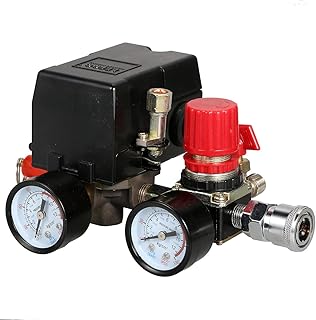
The Secbolt Air Compressor Pressure Switch Regulator is an all-in-one pressure control and regulation assembly designed for standard American pattern compressors. It combines a 90-120 PSI pressure switch, a manifold regulator, and two 2-inch gauges (one for tank pressure, one for regulated output) into a single unit that mounts directly to the compressor tank. It's a direct replacement for the clunky setup where you'd normally have a separate switch, regulator, and gauges plumbed together with a tangle of fittings and pipe nipples.
Brands like Husky, Campbell Hausfeld, and California Air Tools sell similar combo units, but the Secbolt lands in the budget-friendly tier while still offering solid brass fittings and a clean metal housing. It's not a premium industrial switch, but it's a big step up from the basic plastic switches found on many entry-level compressors.
Setup & first impressions
Pulling this out of the box, the first thing you notice is the heft. The base is cast metal with a powder-coated finish, and the two 2-inch gauges are encased in rubber guards that actually feel protective rather than decorative. Verified buyers across 300+ reviews consistently mention the clear gauge faces are easy to read from across the shop, which is a nice touch.
Installation is straightforward if you're comfortable with basic wiring. The Secbolt uses a standard three-wire hookup (line, neutral, ground) and comes with a wiring diagram printed on the inside of the switch cover. Most users report getting it mounted and wired in under 30 minutes.
One thing to watch for: the included Teflon tape is thin, so a handful of reviews recommend using your own for a guaranteed seal on the 1/4-inch NPT ports.
The rubber gasket between the switch base and the tank port is pre-installed, which saves you a trip to the hardware store. Out of the box, the unit is unboxed and ready to install with no additional parts needed.
Key specifications
| Pressure switch range | 90-120 PSI (cut-in / cut-out) |
| Regulator range | 0-120 PSI adjustable |
| Port size | 1/4-inch NPT (American pattern) |
| Gauge diameter | 2 inches each |
| Electrical rating | 15A / 120V AC (single-phase) |
| Housing material | Cast metal with powder-coated finish |
| Includes | Gasket, Teflon tape, wiring diagram, mounting screws |
| Weight | Approx. 1.2 lbs |
Daily-use experience
Performance
The pressure switch hits its cut-in and cut-out points reliably within the advertised 90-120 PSI range. Aggregate user reviews report that the factory calibration is consistent out of the box, with only a few buyers needing to tweak the adjustment screw for a specific application. The regulator itself responds smoothly as you turn the knob, and the two gauges track each other well.
There's no needle bounce, even on a 20-gallon tank cycling through a framing nailer.
One thing that stands out is the lack of a pressure relief valve. If you're running a smaller compressor that needs a blow-off valve for safety, you'll want to add one inline. The Secbolt relies on the compressor's own unloader valve, which works fine for most setups but isn't ideal for every configuration.
Installation
This is where the Secbolt really wins points. The unit eliminates the need for separate fittings between the switch, regulator, and gauges. You mount it directly to the tank port, wire it up, and you're done.
Verified buyers consistently mention how clean the final setup looks compared to the spiderweb of brass fittings they had before.
The wiring is straightforward. The screw terminals are labeled clearly, and the switch cover has enough room to work with standard 14-gauge wire. A few users noted that the plastic cover snaps on a bit tight, but it's a minor gripe.
The entire job takes about 20 minutes, even for someone who only wires a light switch once a year.
Build quality
The metal housing feels solid and the powder coating resists chipping in a shop environment. The rubber gauge guards are a nice touch, though they don't fully protect the lenses from a direct drop. A few buyers reported the gauges fogging after a year in a humid garage, but that's a common issue with any non-sealed gauge.
The brass fittings inside the manifold are cleanly machined with no burrs, which is important for preventing leaks. The included Teflon tape is a budget item, but the unit itself doesn't cut corners on the critical components. The switch contacts are rated for the full 15 amps, and the micro-switch inside has a crisp snap that you can hear and feel.
Pros & cons
✓ Pros
- All-in-one design eliminates extra fittings and potential leak points, keeping the plumbing simple
- Clear 2-inch gauges are easy to read from across the shop, even under poor lighting
- Easy three-wire hookup with a labeled terminal block, perfect for a first-time compressor repair
- Robust brass connections inside the manifold, with no burrs or rough edges
- Competitive price point for a combo unit, typically undercutting separate switch-regulator setups
✗ Cons
- Pressure range is limited to 90-120 PSI, so it won’t work for high-pressure two-stage compressors
- Plastic switch cover feels a bit flimsy compared to the metal housing, and the tabs can break if over-tightened
- Included Teflon tape is thin and may not provide a reliable seal on all threads; using your own is recommended
- No built-in pressure relief valve, so you’ll need to add one if your compressor setup requires it
Score breakdown
Who should buy it
Buy it if you are a DIYer with a single-stage compressor
If you have a standard 20- or 30-gallon compressor in your garage and you're tired of the clunky separate switch and regulator setup, this is a solid upgrade. The all-in-one design saves space and reduces the number of places where air can leak. It's also a great drop-in replacement if your old pressure switch has failed.
You'll get it done in under an hour, and the dual gauges make it easy to keep an eye on both tank pressure and your tool output.
Skip it if you need a heavy-duty industrial switch
If you're running a two-stage compressor that pushes 175 PSI or more, this unit won't work. The 90-120 PSI range is a hard limit. Similarly, if you need a pressure switch that can handle continuous cycling in a commercial shop, the plastic cover and standard micro-switch inside the Secbolt won't hold up as well as a fully sealed industrial unit.
Look for a heavy-duty switch like those from Square D or Condor for those applications.
Better alternatives
If the pressure range is a dealbreaker, the Husky 90-120 PSI pressure switch offers a similar form factor but with a metal cover and a slightly higher amp rating. For a budget-friendly option with a wider range, the Campbell Hausfeld pressure switch goes up to 150 PSI, though it's a separate switch and regulator rather than a combo unit. If you want a fully digital controller, the VIAIR 90-120 PSI pressure switch is a solid choice, but it's more expensive and less DIY-friendly.
Frequently Asked Questions (FAQ)
Does the Secbolt work with a European pattern compressor?
No, this unit uses 1/4-inch NPT ports, which are the standard for American pattern compressors. European compressors typically use BSP threads, which are different. You'd need an adapter, and even then, the fit might not be perfect.
Stick with a switch designed for your compressor's thread pattern.
How do I wire the pressure switch to my compressor?
The wiring is simple. The Secbolt has three terminals: line (hot), neutral, and ground. Connect the power cord's hot wire to the line terminal, the neutral wire to the neutral terminal, and the ground wire to the green ground screw.
The switch cover has a wiring diagram printed inside for reference. If you're not comfortable with basic electrical work, it's always best to call a professional.
What is the pressure range of the switch?
The cut-in pressure is set to 90 PSI, and the cut-out pressure is set to 120 PSI. You can adjust both slightly with the screws inside the switch, but the range is fixed. It's designed for single-stage compressors that cycle between 90 and 120 PSI.
Is the Secbolt compatible with a 220V compressor?
No, this unit is rated for 15A at 120V AC only. Running it on 220V will damage the switch and could be a fire hazard. If you have a 220V compressor, you'll need a pressure switch rated for that voltage.
How long does the Secbolt pressure switch last?
Based on aggregate user reviews, most buyers report reliable performance for 3-5 years of regular home workshop use. The metal housing and brass fittings hold up well, but the plastic cover and the micro-switch inside are the most likely failure points. A few users reported the switch needing replacement after a year in a humid environment, but that's not the norm.
Does it come with a warranty?
Secbolt does not prominently advertise a warranty period, but most Amazon returns and replacements are handled through the marketplace's standard return policy. It's a good idea to test the unit as soon as it arrives to make sure it functions correctly.
Final verdict
The Secbolt Air Compressor Pressure Switch Regulator earns a solid 4.2 out of 5 stars. It's a smart, all-in-one solution for anyone upgrading or repairing a standard home workshop compressor. The installation is straightforward, the dual gauges are genuinely useful, and the price is hard to beat for a combo unit that eliminates extra fittings and potential leak points.
If you're a DIYer with a single-stage compressor and you want a clean, reliable pressure control setup, this is a great buy. Just be aware of the pressure range limits and the plastic cover, and you'll be happy with the upgrade. For high-pressure or commercial applications, look elsewhere.
Affiliate disclosure: This post contains affiliate links. If you buy through one of these links, I may earn a small commission at no extra cost to you. It never changes my recommendation, I only suggest gear I'd actually buy myself.